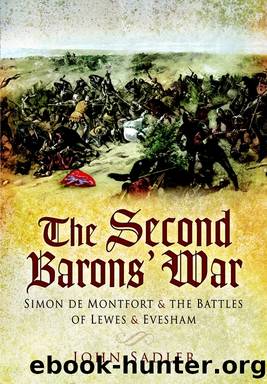
The Second Barons' War by John Sadler
Author:John Sadler [Sadler, John]
Language: eng
Format: epub
Tags: History, Europe, Medieval, Ancient, General
ISBN: 9781783460830
Google: 7WLNDwAAQBAJ
Publisher: Casemate Publishers
Published: 2009-04-21T00:29:57+00:00
The âMiseâ of Lewes
Though he still had the upper hand Simonâs position was far from secure. He did not want to precipitate a general attack on the priory which could see the King of England and his eldest son, together with so many noble knights, killed; equally he could not risk a successful breakout â a siege risked fresh contingents of royalists coming up and another trial of arms. None of these possibilities appealed: what the earl needed was a quick solution, a negotiated peace. One expedient was the threat to put to death the royalist prisoners: these included Richard of Cornwall, the earls of Hereford and Arundel, William Bardolf, Robert de Tateshale, Roger de Somery, Henry Percy and the badly wounded Philip Basset, but Edward had taken John Giffard and his neck could be used to balance the scales. If threats could not avail then it was time for diplomacy â as the shadows lengthened into evening on the 14th and on the morning of the 15th, envoys clad in the pacific hues of the clergy shuttled back and forth. Both sides had much to debate, and the gathering of magnates at the kingâs table that night cannot have been a cheerful one.
Henry III, for all his failings, preferred peace to war. Even his bellicose son could detect the extreme weakness of their present position; any resumption of hostilities could only bring fresh disasters. De Montfort appeared to hold the aces, but his position remained vulnerable unless a workable accord could be brokered. The bones of the deal rested upon the Provisions of Oxford, the core of the baronial manifesto; to these the king now proposed to acquiesce. We can only imagine the reaction of his son to such surrender, but there were important concessions. The first of these concerned the Provisions themselves: though they were to stand as drafted in the first instance a further process of review and arbitration would be entered into.17 Second, and this was to have important repercussions, the king, Prince Edward and Cornwallâs son Henry would remain under some form of restraint; Mortimer, James of Audley and Roger of Leybourne would be granted their liberty. This latter was significant and undermined the baronial triumph of what became known as the Mise of Lewes. Mortimer was an inveterate foe of de Montfort, powerful and energetic: with his power base on the Welsh marches and a large affinity the marcher lord could yet be a prime player in the game, and the game, with Mortimer unfettered, was by no means over.
On 15 May, King Henry III of England handed his regal sword to de Clare; he and his son passed into effective captivity and the reins of government transferred to Simon de Montfort. It was the earlâs greatest triumph but it was neither unconditional nor perfect. The earl would find that the winning of power came easier than its retention, that his freeing of the Marchers was most dangerous and that his subsequent failure to
Download
This site does not store any files on its server. We only index and link to content provided by other sites. Please contact the content providers to delete copyright contents if any and email us, we'll remove relevant links or contents immediately.
| Africa | Americas |
| Arctic & Antarctica | Asia |
| Australia & Oceania | Europe |
| Middle East | Russia |
| United States | World |
| Ancient Civilizations | Military |
| Historical Study & Educational Resources |
Room 212 by Kate Stewart(5183)
The Crown by Robert Lacey(4862)
Endurance: Shackleton's Incredible Voyage by Alfred Lansing(4845)
The Iron Duke by The Iron Duke(4405)
The Rape of Nanking by Iris Chang(4255)
Joan of Arc by Mary Gordon(4156)
Say Nothing by Patrick Radden Keefe(4043)
Killing England by Bill O'Reilly(4042)
I'll Give You the Sun by Jandy Nelson(3496)
Shadow of Night by Deborah Harkness(3412)
Hitler's Monsters by Eric Kurlander(3385)
Mary, Queen of Scots, and the Murder of Lord Darnley by Alison Weir(3240)
Blood and Sand by Alex Von Tunzelmann(3240)
Eleanor & Park by Rainbow Rowell(3237)
Darkest Hour by Anthony McCarten(3161)
Margaret Thatcher: The Autobiography by Thatcher Margaret(3113)
Book of Life by Deborah Harkness(2984)
Red Famine: Stalin's War on Ukraine by Anne Applebaum(2970)
The One Memory of Flora Banks by Emily Barr(2898)
